A single-storey kitchen extension in England typically costs £3,400 to £6,700 per m² all in, including the kitchen, fees and VAT. That means about £76k to £134k for a 20 m² room outside London and £103k to £172k in London. Use the calculator for your own size and finish.
Updated 2 November 2026 · Typical England ranges, explained below
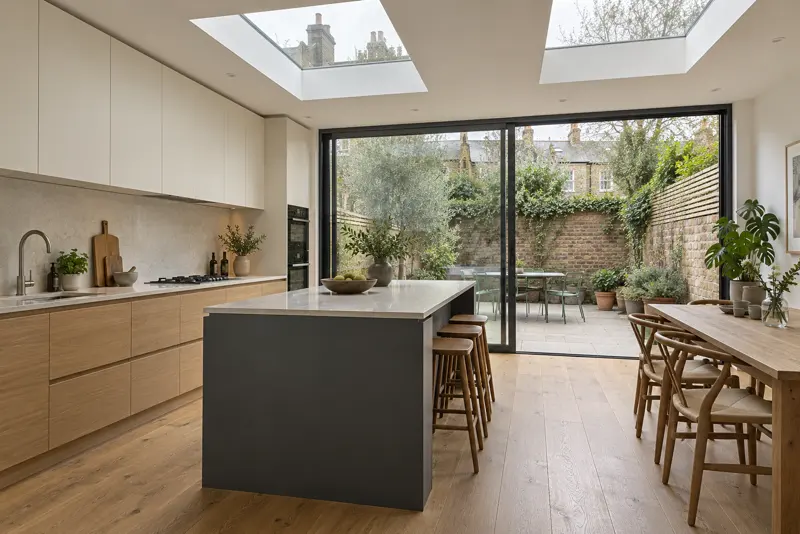
One-storey extension across the back of a terraced house: flat roof, two rooflights and wide sliding doors.
Kitchen extension cost calculator
Pick your size and finish. The range updates as you go, with every line shown underneath.
Your estimate
Enter a floor area to see a range.
Kitchen extension cost per square metre
Headline "per m²" prices often leave out the kitchen, the fees or the VAT. We keep them apart so you can see what each figure includes. These are the rates inside the calculator, set in November 2026 from published UK price guides by builders, trade platforms and cost consultants, sitting in the middle of their ranges.
Rates per m² of new floor, excluding VAT
Shell type
Outside London
London
Rear extension
£1,800 to £2,700
£2,700 to £3,900
Side return infill
£2,200 to £3,200
£3,100 to £4,400
Wraparound
£2,100 to £3,000
£2,900 to £4,200
The shell is the finished empty room: foundations, drainage, walls, an insulated roof, one set of doors and one rooflight, steel beams to open up the back wall, wiring and plumbing, plaster, screed and paint. Side returns cost more per m² because they are narrow, run along a party wall and usually have a long glazed roof. Underfloor heating, usually £60 to £120 per m² for a wet system laid in the screed, sits inside the upper half of these ranges.
On top of the shell the calculator adds: glazing upgrades (£4k to £9k for wide sliders and a second rooflight, £10k to £25k for structural glass), the kitchen, design and structural engineering at 10 to 15% of the build, building control at £900 to £1,800, party wall surveyors at £1,000 to £3,000 per award, the statutory planning fee, a 10% contingency and 20% VAT.
Small kitchen extension costs
Small extensions cost more per m² because the foundations, steel beam, drainage connection and fees cost almost the same at 8 m² as at 15 m². The calculator raises the shell rate by 2% for every m² below 15, up to 20%.
Rear extension, mid kitchen, more glazing, permitted development, one party wall award, with VAT
New floor
Example footprint
Outside London
London
All-in per m²
8 m²
2 m × 4 m side return
£48k to £89k
£60k to £108k
£5,950 to £13,500
10 m²
2.5 m × 4 m
£53k to £97k
£68k to £119k
£5,250 to £11,900
15 m²
3 m × 5 m
£63k to £113k
£83k to £142k
£4,200 to £9,500
20 m²
4 m × 5 m
£76k to £134k
£103k to £172k
£3,800 to £8,600
25 m²
5 m × 5 m
£89k to £154k
£122k to £201k
£3,550 to £8,050
30 m²
5 m × 6 m
£102k to £174k
£142k to £230k
£3,400 to £7,650
40 m²
wraparound size
£128k to £215k
£181k to £289k
£3,200 to £7,200
The low end of each range is a plain flat-roofed box with a straightforward kitchen built by a small local firm. The high end is a London-standard finish with a lot of glass and full fees. Most real quotes land in the middle third.
Worked example: 20 m² rear extension outside London
Calculator lines, excluding VAT
Line
Low
High
Shell, 20 m² × £1,800 to £2,700
£36,000
£54,000
Glazing upgrade
£4,000
£9,000
Mid-range kitchen, fitted
£12,000
£25,000
Design and engineering
£4,000
£9,450
Building control
£900
£1,800
Lawful development certificate (no VAT)
£274
£274
One party wall award
£1,000
£3,000
Contingency, 10%
£5,200
£8,800
Total before VAT, rounded
£63,000
£111,000
Total with 20% VAT, rounded
£76,000
£134,000
Swap to a budget kitchen, basic glazing and no party wall award and the same room comes down to about £61k to £99k. A high-spec kitchen with the same basic glass takes it to £86k to £149k.
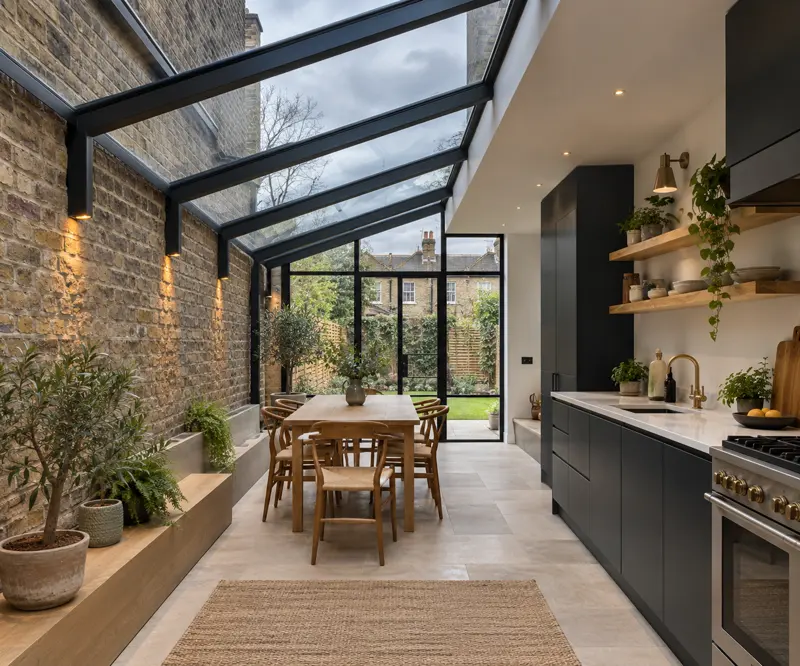
A side return infill. The glazed roof along the party wall is a big part of the higher cost per m².
Kitchen extension costs in London
In London the all-in cost for a single-storey rear kitchen extension in 2026 typically runs from about £4,500 to £8,600 per m² of new floor, depending on size. A 20 m² extension with a mid-range kitchen is roughly £103k to £172k, and a 30 m² wraparound comes out higher still. The shell alone, before the kitchen, fees and VAT, is typically £2,700 to £3,900 per m² for a rear extension.
Why London costs more
Getting materials in. Many terraces have no side access, so every bag and every steel comes through the house. That means floor protection, slower work and often a grab lorry, plus council permits for a skip or a suspended parking bay.
Neighbours on both sides. Work on or near a shared wall falls under the Party Wall etc. Act 1996. If a neighbour does not give written consent, a surveyor's award is needed for each one, and you pay for it.
Old drains and clay. Clay soils, nearby trees and shared Victorian drains are common. If you build over a public sewer, or within 3 m of one, your water company has to agree it first through a build-over agreement.
Bigger ambitions. London schemes tend to carry more glass, more steel and more bespoke joinery. These are choices; the glazing and kitchen settings in the calculator show what each one adds.
It also helps to think about how the room will be used before choosing a shape. Cooking, eating and sitting in one space changes where the island goes, where the doors go and how much light you need at the back of the house. For a practical view from a builder, see how a kitchen extension changes the way a London home is used, then come back and run the numbers here.
Many London streets sit in conservation areas or under Article 4 directions, which take away some permitted development rights. Look at your council's planning map before assuming no application is needed. Flats and maisonettes have no householder permitted development rights at all.
What the kitchen itself costs
The kitchen is a separate budget from the building, and it is the line people most often forget when they compare per m² prices.
Fitted kitchen for a new extension, England, 2026, excluding VAT
Level
What you typically get
Typical cost
Budget
Flat-pack or trade units, laminate worktops, own-brand appliances, fitting
£6,000 to £12,000
Mid
Rigid units, an island, quartz or solid wood tops, mid-range appliances
£12,000 to £25,000
High
Painted in-frame or bespoke units, stone tops, premium appliances
£25,000 to £50,000
Units are usually about half of the kitchen figure, with worktops, appliances and fitting making up the rest. If the island is the main reason for the extension, check it fits before the walls go up with the island planner. Moving the room 300 mm wider at drawing stage costs little; finding you are 300 mm short after the build costs a lot.
Building regs, planning and other fees
You will need Building Regulations approval for practically any extension. It is separate from planning and covers structure, fire safety, insulation, ventilation and drainage. Building control from your council or an approved inspector typically costs £900 to £1,800 for a single-storey extension. LABC's homeowner guidance explains the plan check and site inspections.
Under the Town and Country Planning (General Permitted Development) (England) Order 2015, Schedule 2, Part 1, Class A, a single-storey rear extension can usually project up to 3 m from the original rear wall of an attached house, or 4 m for a detached house, without a planning application. The larger home extension prior approval raises this to 6 m and 8 m. The extension can be no taller than 4 m, and where it comes within 2 m of a boundary its eaves are capped at 3 m. A side extension must be single storey and no wider than half the original house. A wraparound counts as both, so it normally needs a householder application. The government's permitted development technical guidance has diagrams for each case.
Consents and fees in England (fees from 1 April 2026)
Route
When
Fee
Permitted development
Within the limits above, a house, no Article 4
£0
Lawful development certificate
Proof that the work is permitted; buyers' solicitors often ask
£274
Prior approval, larger home extension
Rear extension 3 to 6 m deep (4 to 8 m detached)
£249
Householder planning application
Anything outside permitted development
£548
Building control
Every extension
about £900 to £1,800
A draft change to the fee regulations, if approved by Parliament, would raise the householder fee to £575 and the larger home extension prior approval fee to £310 from 8 December 2026. The Planning Portal fee guidance shows the fee in force on the day you apply. Applying online through the Portal adds a £75.83 plus VAT service charge; applying direct to your council avoids it. Scotland, Wales and Northern Ireland set their own fees.
VAT and the costs people forget
Building an extension to an existing home is standard-rated: 20% VAT on labour and materials if the builder is VAT registered. A sole trader under the VAT threshold will not charge it, which is one reason quotes can differ so much. Often missing from first quotes:
Flooring through both the new and the old room, so there is no step or joint.
Moving the boiler, gas meter or soil stack.
A new consumer unit if the old one cannot take more circuits.
Making good the garden, patio and fences.
Blinds for rooflights and large doors.
Eating out or living elsewhere for some of the 3 to 4 months on site.
What £20k, £50k and £100k actually buy
Can I build an extension for £20k?
Not a kitchen extension. £20,000 including VAT will pay for a mid-range kitchen refit in the existing room, or a small porch or garden room. The smallest extension in our calculator, 8 m² with a budget kitchen, basic glass and no party wall award, still comes to about £33k to £55k.
Is £50k enough to renovate a house in the UK?
For a refurbishment, often yes: a new kitchen in the existing room, a bathroom, rewiring and decoration. For a kitchen extension plus anything else, no. Outside London, £50k covers a small 8 to 10 m² extension with a budget kitchen and plain glazing, with little left over.
What does £100k get?
Outside London, a 20 to 25 m² rear extension with a mid-range kitchen, decent glazing and full fees, with some contingency left. In London, about 15 m² on similar terms, at the lower end of the range (£83k to £142k).
Where to save
Keep the shape a simple rectangle with a flat roof. Each corner, step or roof change adds labour.
Use standard-size doors and rooflights instead of made-to-measure glass.
Keep the sink near the existing drain run to avoid new manholes.
Get drawings first, then three itemised quotes that split shell, glazing, kitchen and provisional sums.
Pay in stages tied to finished work, never a large sum up front.
For a 20 m² single-storey rear kitchen extension outside London with a mid-range kitchen, our estimator gives about £76,000 to £134,000 including VAT, fees, one party wall award and a 10% contingency. The same room in London comes out at roughly £103,000 to £172,000.
Can I build an extension for £20k?
Not a kitchen extension with a new kitchen in it. £20,000 can pay for a small porch, a garden room or a kitchen refit inside the existing walls. Even the smallest case in our estimator, an 8 m² rear extension with a budget kitchen and basic glass, comes to about £33,000 to £55,000 once foundations, steel, fees and VAT are counted.
Is £50k enough to renovate a house in the UK?
It can be, if the work is cosmetic or limited to one or two rooms: a new kitchen in the existing room, a bathroom, rewiring and decoration. It is not enough for a kitchen extension plus a whole-house renovation. In our estimator a small 8 to 10 m² extension with a budget kitchen already uses most or all of £50,000 on its own.
How long does a kitchen extension take?
Allow 2 to 4 months for design, drawings and any planning decision (8 weeks for a householder application, up to 42 days for prior approval), then about 12 to 16 weeks on site for a single-storey rear extension. The kitchen is usually out of use for 4 to 8 weeks of that.
Does a kitchen extension add value?
Usually yes, because it adds floor area and buyers pay for a good kitchen and garden link. Whether it adds more than it costs depends on the ceiling price of your street. Ask a local estate agent for the value with and without the extension before you commit.
Do I pay VAT on a kitchen extension?
Yes. Extending an existing home is standard-rated at 20% when your builder is VAT registered. Statutory planning fees carry no VAT.